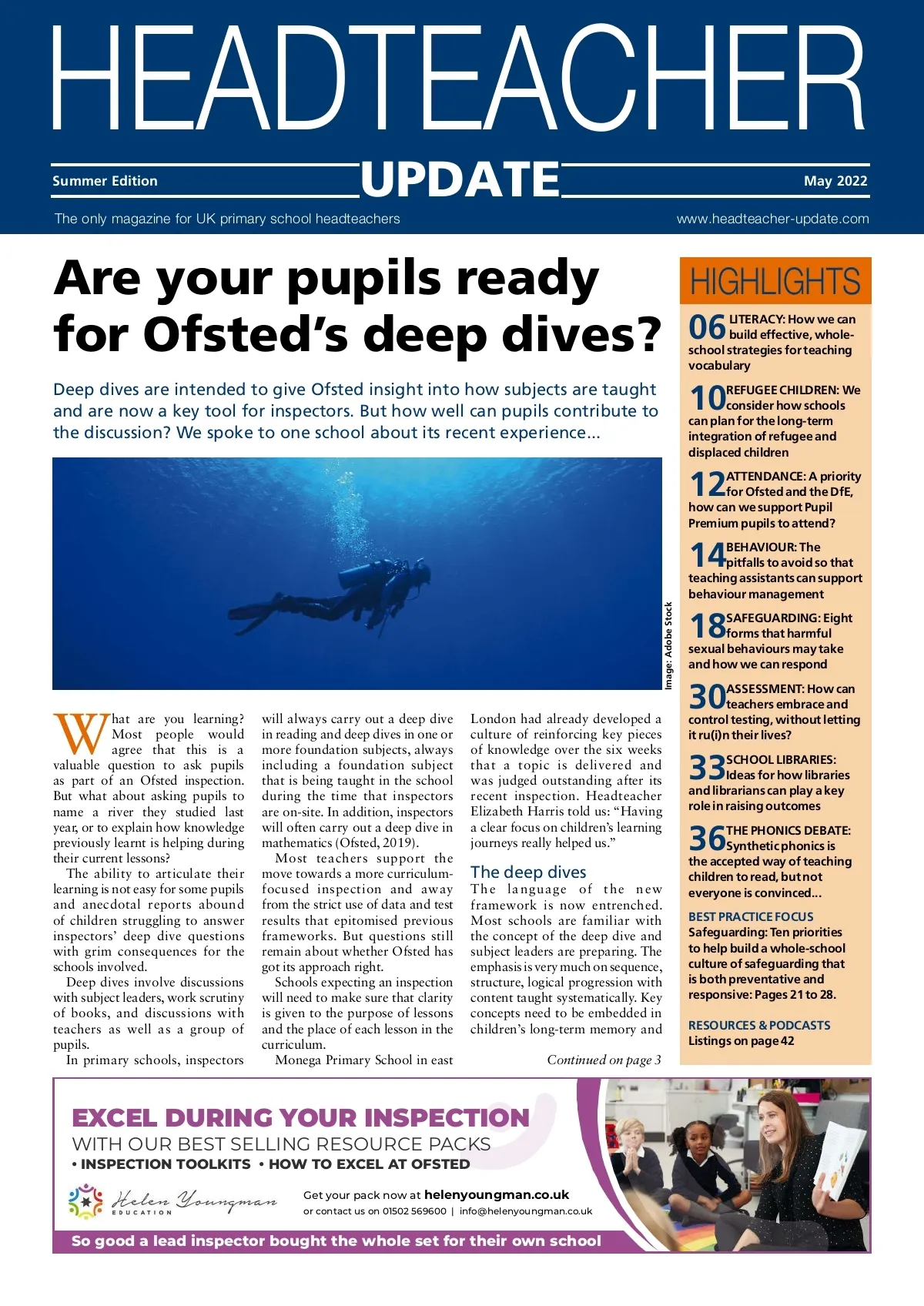
HEADTEACHER Summer Edition UPDATE May 2022 www.headteacher-update.com The only magazine for UK primary school headteachers Are your pupils ready for Ofsted’s deep dives? Deep dives are intended to give Ofsted insight into how subjects are taught and are now a key tool for inspectors. But how well can pupils contribute to the discussion? We spoke to one school about its recent experience... HIGHLIGHTS LITERACY: How we can build effective, whole-school strategies for teaching vocabulary REFUGEE CHILDREN: We consider how schools can plan for the long-term integration of refugee and displaced children ATTENDANCE: A priority for Ofsted and the DfE, how can we support Pupil Premium pupils to attend? BEHAVIOUR: The pitfalls to avoid so that teaching assistants can support behaviour management Image: Adobe Stock 06 10 12 14 18 30 33 36 SAFEGUARDING: Eight forms that harmful sexual behaviours may take and how we can respond ASSESSMENT: How can teachers embrace and control testing, without letting it ru(i)n their lives? SCHOOL LIBRARIES: Ideas for how libraries and librarians can play a key role in raising outcomes THE PHONICS DEBATE: Synthetic phonics is the accepted way of teaching children to read, but not everyone is convinced... BEST PRACTICE FOCUS Safeguarding: Ten priorities to help build a whole-school culture of safeguarding that is both preventative and responsive: Pages 21 to 28. RESOURCES & PODCASTS Listings on page 42 W hat are you learning? Most people would agree that this is a valuable question to ask pupils as part of an Ofsted inspection. But what about asking pupils to name a river they studied last year, or to explain how knowledge previously learnt is helping during their current lessons? The ability to articulate their learning is not easy for some pupils and anecdotal reports abound of children struggling to answer inspectors’ deep dive questions with grim consequences for the schools involved. Deep dives involve discussions with subject leaders, work scrutiny of books, and discussions with teachers as well as a group of pupils. In primary schools, inspectors will always carry out a deep dive in reading and deep dives in one or more foundation subjects, always including a foundation subject that is being taught in the school during the time that inspectors are on-site. In addition, inspectors will often carry out a deep dive in mathematics (Ofsted, 2019). Most teachers support the move towards a more curriculum-focused inspection and away from the strict use of data and test results that epitomised previous frameworks. But questions still remain about whether Ofsted has got its approach right. Schools expecting an inspection will need to make sure that clarity is given to the purpose of lessons and the place of each lesson in the curriculum. Monega Primary School in east London had already developed a culture of reinforcing key pieces of knowledge over the six weeks that a topic is delivered and was judged outstanding after its recent inspection. Headteacher Elizabeth Harris told us: “Having a clear focus on children’s learning journeys really helped us.” The deep dives The language of the new framework is now entrenched. Most schools are familiar with the concept of the deep dive and subject leaders are preparing. The emphasis is very much on sequence, structure, logical progression with content taught systematically. Key concepts need to be embedded in children’s long-term memory and Continued on page 3 EXCEL DURING YOUR INSPECTION WITH OUR BEST SELLING RESOURCE PACKS • INSPECTION TOOLKITS • HOW TO EXCEL AT OFSTED Get your pack now at helenyoungman.co.uk or contact us on 01502 569600 | info@helenyoungman.co.uk So good a lead inspector bought the whole set for their own school
Head Teacher Update Summer Term 2022: Page 1